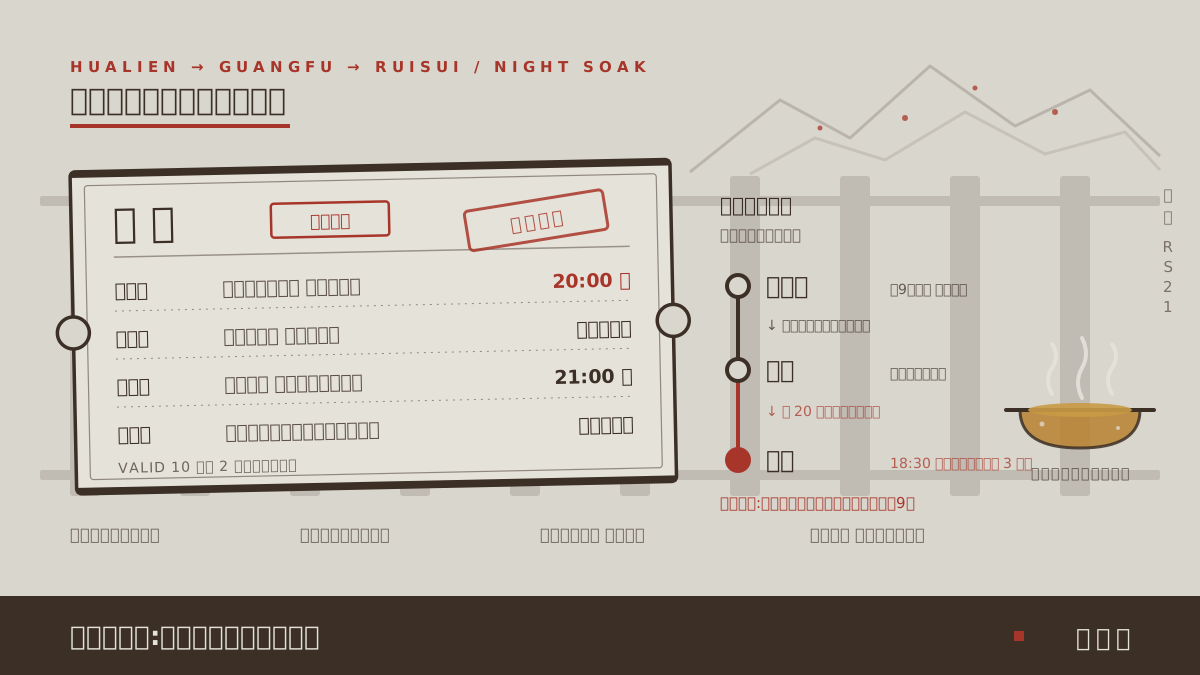
The destination on this ticket isn’t a bar strip. It’s a tub of amber water.
Ruisui sits about twenty minutes south of Guangfu — strictly past the edge of the Fenglin & Guangfu page — but when it comes to soaking, nothing else on this valley line does it as properly. Treat it as the extended section of the same service. It runs smoothly that way.
Ticket face: what the golden spring is
Ruisui’s water is an iron-rich chloride carbonate spring. The iron oxidises on contact with air, the water turns a rusty amber, and a towel left in it too long picks up a faint tea stain — locals call it the golden spring. Not a marketing line. Chemistry.
The bath area is not in town. Head out past the main street toward the Wenquan Road stretch, about three kilometres, and that’s where the private bathhouses, hot-spring guesthouses and hotels cluster. “Arrive at Ruisui Station, arrive at the springs” is the most common misreading of this ticket.
Arrival and ticket punch
TRA Ruisui Station gets local trains and some express services. From the station to the bath area there’s still a stretch of road, and taxi supply in town is limited at night — ask your lodging about pick-up when you book, which beats gambling on a ride after you step off.
Driving, take Highway 9: about an hour south from Hualien City, about twenty minutes down from Guangfu.
Dinner row: before eight, non-negotiable
Dinner in town happens early. The eateries and lunchbox shops on the main street mostly close by seven or eight, and the tea houses up on the Wuhe plateau belong to the afternoon — don’t expect them to carry the evening.
This site’s position, said plainly: seated by 6:30 pm is the safe call; roll into town after eight and a convenience store is most of what’s left. Rather than doubling back out of the bath area hunting for food, eat first, then go up.
Bathing row: after nine, the only lights are indoors
This is Ruisui’s night as it actually is. Past nine the streets go near-silent, and the lights still burning are almost all inside hot-spring hotels and bathhouse courtyards.
Which is why this evening runs in reverse of a city night — you don’t finish dinner and go looking for a programme. The soak is the programme. Bath hours and private-room rates vary widely from house to house; go by what each one posts, and phone ahead before you set out.
Pick the season right: October to February. When the northeast monsoon comes down, valley nights often sit in the low teens Celsius, and white steam lifts off the amber water — a picture summer cannot give you. Afterwards, sit in the courtyard; light pollution is low, and on a clear night the stars are just there, the same logic covered in valley versus coast at night.
A drink in the room is fine. Drink, and the car keys stay put until morning — no designated drivers wait around the valley at night, and Highway 9 after alcohol is never on the table.
Return row: northbound legs
Staying the night is the correct answer. If you must move: about twenty minutes north to Guangfu, thirty-five or so to Fenglin — the slow-city side of that run is laid out in the honest Fenglin & Guangfu rundown — or straight back to Hualien City, about an hour on Highway 9, with heavy trucks and long gaps between streetlights after dark. Ease off.
Train riders, note one thing: evening local services on the valley line end early, and the last train is whatever TRA’s timetable says for that day. Check it before you get in the water, not halfway through the soak. The full homebound logic is in getting home at night in Hualien, and if you’d rather end the night on a massage table, the list is under Hualien City massage — that’s an hour north, a later chapter.
Back-of-ticket fine print
The Tropic of Cancer Marker Park stands right beside Highway 9 on the Wuhe plateau. A daytime stop on the way. No lights at night, no detour needed.
There is no late-night food street inside the bath area — bring your own snacks and water.
This ticket carries a single stamp: eat early, bathe early, sleep early. Match the town’s rhythm, and one night here earns back the fare.