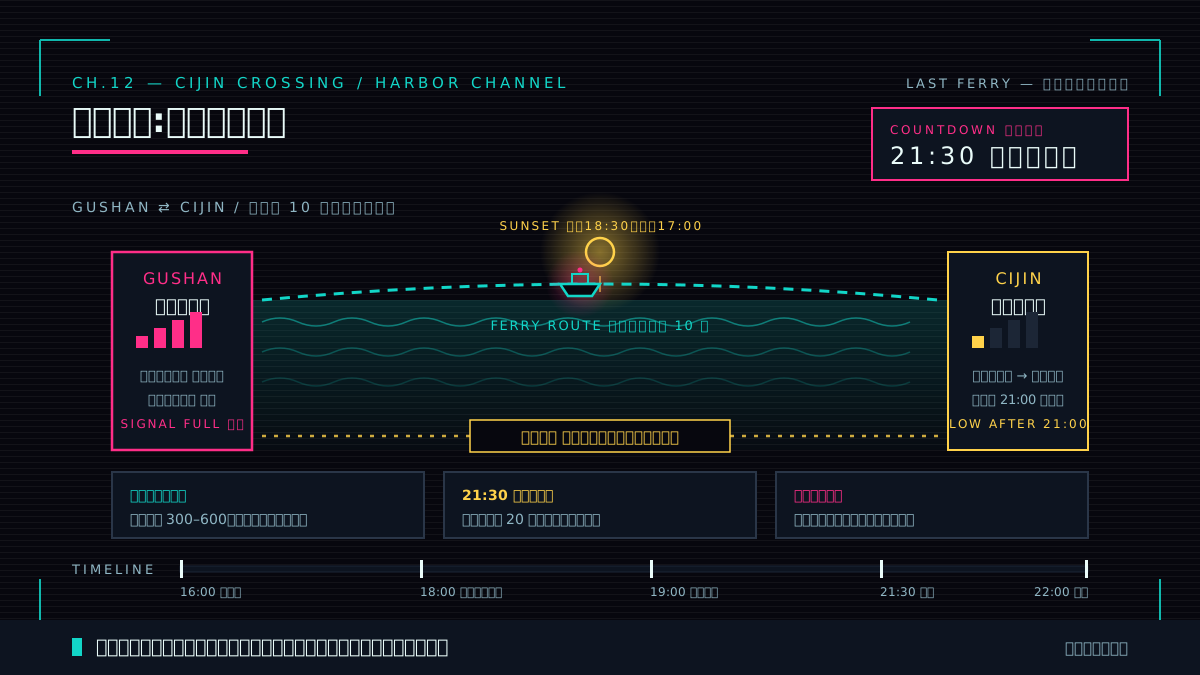
Cijin's night doesn't run on the clock — it runs on the ferry timetable. When the boats stop, the island turns its lights down. So the right way to play Cijin is as a dusk island: arrive late afternoon, harvest the sunset, pull out around nine, and hand the main event to Yancheng across the water.
Miaoqian Rd at dusk: peak signal
Step off at Cijin Ferry Pier and Miaoqian Rd is straight ahead — a few hundred metres of old street running all the way to the beach. Four to five in the afternoon is the right entry: seafood restaurants laying out the day's catch, charcoal lighting up under the grilled-squid stalls, tomato slices with ginger-soy paste as the local handshake. Seafood runs NT$300–600 a head, grilled squid about NT$100 a skewer. Haggling isn't this street's culture; comparison shopping is — a dozen-plus stalls on one road, walk the full length before you sit down anywhere.
The Tianhou Temple sits mid-street, incense and charcoal smoke facing each other across the road.
Half an hour before sundown, walk to the beach. In summer, June through September, the sun drops late, around six thirty; in winter it's gone a little past five — check the day's time before you set out. Walk back after the light fades and Miaoqian Rd is right on dinner rhythm. This is the one hour of the whole route you shouldn't compress.
After nine: the honest version
Straight up: Cijin's night ends early. Seafood places start clearing tables after eight, and by nine Miaoqian Rd is down to a few grilled-squid stalls and drink shops holding on. Weekends stretch an extra half hour to an hour; weekdays, don't gamble. For late-night food on the island, those few stalls are the whole menu — fine for atmosphere, not for a feast.
So build the itinerary backwards. Don't put Cijin at the end of the night; put it at dusk, and give the back half to the mainland.
The ferry: counting down to the last boat
The Gushan–Cijin route is the main line — about ten minutes across, and scooters roll straight onto the boat, one of the last everyday ride-on crossings left in Taiwan. Headways are tight at peak and stretch off-peak, and the last boat leaves late at night — but timetables get adjusted, so take the last boat and the headway from the pier's posted schedule on the day. Don't memorise old numbers.
The timing rule is simple: if you want the boat back, queue at the pier by nine thirty; on holidays, add another twenty minutes.
Missing the ferry doesn't strand you. The Cross-Harbor Tunnel links Zhongzhou on Cijin to Qianzhen, open around the clock with a scooter lane; riding back downtown takes about twenty to thirty minutes. Without a scooter, the R9 bus runs through the tunnel to the MRT. The tunnel is a backup, not a punishment — just windy and empty late at night, so ease off the throttle.
Back on the mainland: Yancheng takes over
The ferry lands at Gushan Ferry Pier, a few minutes' walk from MRT Sizihwan station, and the Orange Line is one stop to Yanchengpu — round two starts here.
For a proper sit-down drink, 鸚鵡螺餐酒館 at No. 117 Wufu 4th Rd has 2,300-plus reviews at 4.8, about as front-of-house as Yancheng bistros get. Live music is at 美德客音樂餐酒館, No. 43 Qixian 3rd Rd, 1,500-plus reviews and the same 4.8. 高雄溫室酒吧 on the second floor of No. 55 Daren Rd hides deeper — 300-plus reviews, right for a lower-volume second half. And after a full day on your feet, 善水堂養生概念館 at No. 128 Wufu 4th Rd gives your legs back, with 900-plus reviews vouching for it.
One ugly truth: neither a boat deck nor a scooter seat is anywhere to be after drinking. That beer with your seafood on Cijin commits you to the ferry-plus-MRT route home, or a designated driver — if you wheeled a scooter onto the boat, decide who's riding before you open anything.
The first half of this route is written up in Sizihwan and Hamasen after sunset; for the full second-half menu see the Yancheng guide and Yancheng bars, and to fold in Pier-2, the Pier-2 night guide has the walkthrough.