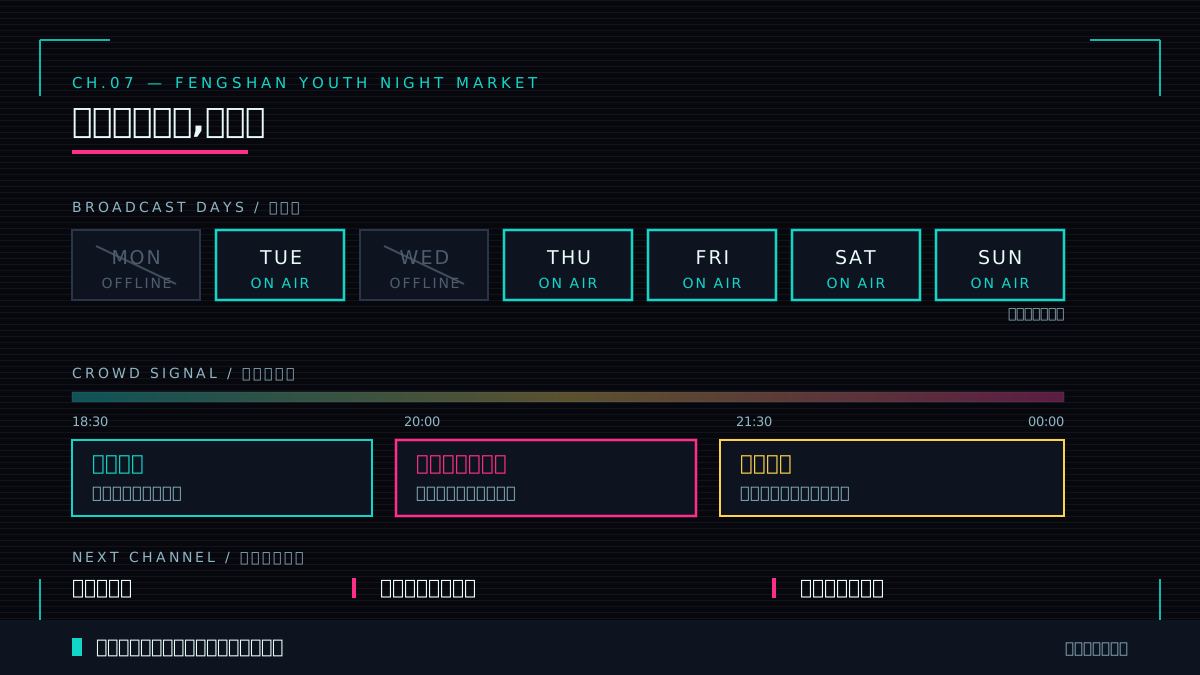
The first lesson at Youth Night Market is not what to eat. It is which day it opens.
Turn up on a Monday or a Wednesday and you will find an empty street.
Trading days: read the notice before you leave
Main trading days are Tuesday, Thursday, Friday, Saturday and Sunday, subject to on-site notices. This is one of Kaohsiung’s larger markets with an overwhelming local ratio — but it does not trade daily, a point misread about as often as typhoon closures.
Check the day’s notice before setting out. Thirty seconds saves a wasted trip.
Arrival windows: pick one of three
6:30 to 7:30 is the opening window. Stalls come ready in sequence, lines are short, and if you want hot food or a seat, this is the comfortable stretch.
Eight to nine is peak. Wenheng Road fills end to end and popular stalls start at fifteen minutes of queueing. If you came for photographs or a relaxed walk, this hour deserves a warning — not because it is bad, but because it is inefficient.
After 9:30 the crowd drains. This is circle-back time: the popular stalls are still trading and the lines have halved. The full local method usually runs like this — arrive early and eat properly, disappear through the middle, return late for something sweet.
The logic of the layout
Grills and stir-fry counters cluster on the main flow; game stalls and clothing sit on the outside. That arrangement has a practical benefit: you do not cross the whole street for one order of grilled meat.
Prices land at NT$200 to NT$300 a head. That gentler tier is the main reason the local ratio runs so high — the same items cost noticeably more at a city-centre market.
No stall names here. Turnover is fast and a fixed list expires; queue where the local accents are thickest.
After eating, which channel
Channel one is Weiwuying. The National Kaohsiung Center for the Arts at No. 1 Sanduo 1st Road opens its banyan plaza and outdoor spaces free after dark, a ten-minute ride for a digestive walk. On performance nights, the departing audience pushes a second peak through nearby dining.
Channel two is a drink. STORY Restaurant at No. 22, Lane 296 Bade Road carries over 2,200 reviews, the strongest numbers among Fengshan’s bistros and bars; Log Bar & Bistro on the second floor at No. 429 Qingnian Road Section 2, Badi Music & Darts Bar at No. 48 Zhongshan West Road and Torii Charcoal Yakitori (Wenlong) at No. 77 Wenlong Road each run their own line. Honestly, Fengshan’s bars are few but genuine; for density, take the orange line into the city, where the city bar primer is the better route.
Channel three is lying flat. Songzulin Foot Wellness at No. 77 Wenbin Road has over 1,300 reviews, Jingdian Foot Wellness on the second floor at No. 247 Qingnian Road Section 2 and Zulaochun Health House at No. 458 sit on the same road, and Xiang Massage Wellness House at No. 171 Jianguo Road Section 2 passes seven hundred. More in Fengshan massage and spa.
To sing, Xiangwenxin KTV (Wujia) at No. 291 Fengnan Road holds over 3,200 reviews and remains southern Kaohsiung’s veteran.
Transport and getting out
Fengshan and Dadong stations on the orange line cover the main points, last trains around midnight; TRA Fengshan runs later as a backup channel. Between the market and Weiwuying is a five-minute ride.
Drivers should park on the edge and walk in. Wenheng Road is effectively unparkable at peak, and a second lap is wasted time.
If you drank, however well you know the old county roads, use a designated driver. For the district as a whole, the Fengshan nightlife guide and the Fengshan district guide follow on.