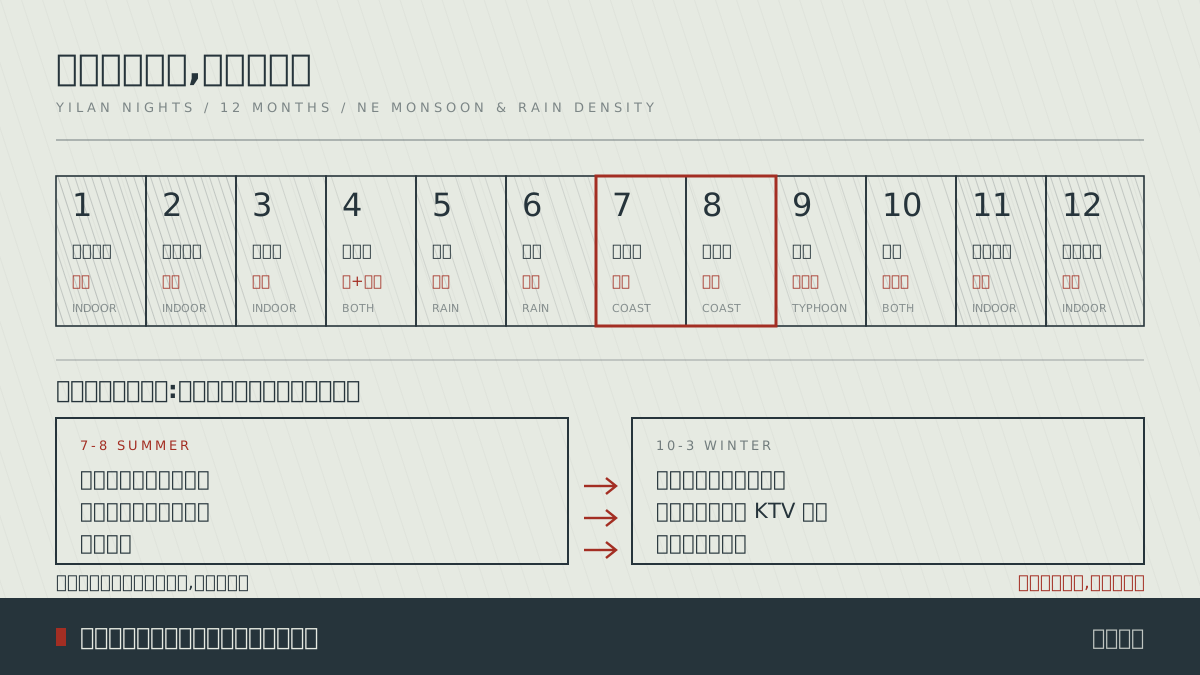
Yilan’s seasons are not a temperature question. They are a wind question.
Get that one thing right and the whole year schedules itself. Driving out to a seaside bar in Wai’ao on a Saturday night in January is the classic local misread — not because the place is bad, but because that coastline is not open for business that month.
October to March: the northeast monsoon, and this is the real Yilan
Half the year. This half is what outsiders remember.
The northeast monsoon runs roughly October into March, and Yilan sits directly on the windward side: cold, wet, windy, and the kind of rain that keeps going for days. Through this stretch the seaside places around Toucheng and Wai’ao often close early, and in bad weather do not open at all. The Lanyang Museum shuts by early evening, and outdoor stops like the viewpoints and Doufu Cape are not worth forcing in the rain.
The night does not disappear. It relocates.
Jiaoxi is the answer for these six months. Winter is peak hot-spring season: most bathhouses on the street run to 11 pm or midnight, the free foot pools at Tangweigou stay open, and foot-massage shops carry on to 1 or 2 am. Which kind of bath to book is covered in the Jiaoxi bathhouse guide.
Luodong takes winter equally well. Parts of the market sit under arcades and awnings, and the whole second half — izakaya, KTV, massage — is indoors. On the genuinely heavy days, the rainy-night indoor plan goes into more detail.
One winter warning: book weekend bathhouses. Jiaoxi rooms and private baths get fought over on winter weekends. Do not ask on the day.
April to early June: the easiest stretch, plus plum rains
April into mid-May is the most comfortable window of the year.
The monsoon has let go, summer’s heat has not arrived, temperatures are right and crowds are moderate — both coastal and indoor plans are live. Sunset at Wushi Harbor followed by dinner back in Luodong runs beautifully in this window.
Then the plum rains. Mid-May into June is a different rain from winter’s: winter drizzles, this pours, and it keeps at it. During that stretch a backup plan is not a bonus. It is the plan.
July and August: the coast wakes up, and the county fills
Summer is the only time “a night by the sea” genuinely works here.
The surf-shop cluster around Wai’ao teaches surfing by day and sells beer by night, casual in feel, and only properly busy in high season — off-peak and in winter these places often close early or not at all, so check the week before you drive out. A beer in the sea breeze with Guishan Island reduced to a black silhouette is a scene only this stretch of coast provides.
The cost is people. July and August coincide with the Children’s Folklore Festival, whose crowds spill from Qinshui Park into Luodong Night Market and Jiaoxi, with lodging prices clearly higher. Book at least a month out. Dodging tactics are in how to avoid the festival crowds.
Also: Su’ao’s cold springs sit around 22°C — a daytime cooling-off in summer, not an evening plan, and certainly not a winter one.
September: the typhoon month
September is the month you actually watch the forecast.
Typhoon season runs roughly July to September and lands hardest in September. When one comes, the coastal and Suhua routes are the first affected — drop the outdoor legs entirely and do not sit in the harbour waiting for it to pass. The gaps between systems, though, are excellent: late September into early October brings cooler air and thinner crowds, and is the most underrated window of the year.
Turning the season, in one line
There is really only one rule: swap the outdoor leg for the indoor one.
Summer’s sea wall becomes winter’s bathhouse. Summer’s Wai’ao bar becomes winter’s Luodong izakaya. Summer’s lakeside walk becomes an old-town lane and one drink. Change the location; the shape of the evening stays the same.
As for Yuanshan and Sanxing — asleep by nightfall in all four seasons. That one has nothing to do with weather, so do not wait until winter to be disappointed.
Last thing: leave extra time when driving on wet nights, because visibility on the provincial and coastal roads is worse than it looks. And if you drink, call a car or arrange a designated driver — waiting on a Yilan roadside in winter is genuinely miserable.